
 Would you like to know who the greatest all-time hitter for average is? Or the most productive ever, measured in team runs generated per PA? Or how about who would be the most proficient in triples if all player in AL/NL history were somehow transported to, oh, 1901?
The new BGW Time Machine can answer these questions!
The Machine is powered by a hierarchical Bayesian engine that over the course of 1900-2025 ranks players’ “latent” or unobserved skill levels within and across 5-year birth cohorts.
I’ll supply more details on the theory behind, the mechanics of, and some of the key insights generated by the Bayesian model that powers the Time Machine.
But for now, let’s focus on the Machine itself!
It lets users evaluate and rank overall player performances in a variety of ways.
For one thing, it can “transport” players to particular seasons. Because game conditions have changed radically over time, skills along different dimensions—power and contact—can translate into different distributions of offensive performance outcomes (singles, doubles, triples, homers, walks, and HBPs) depending on the season in which the translation occ
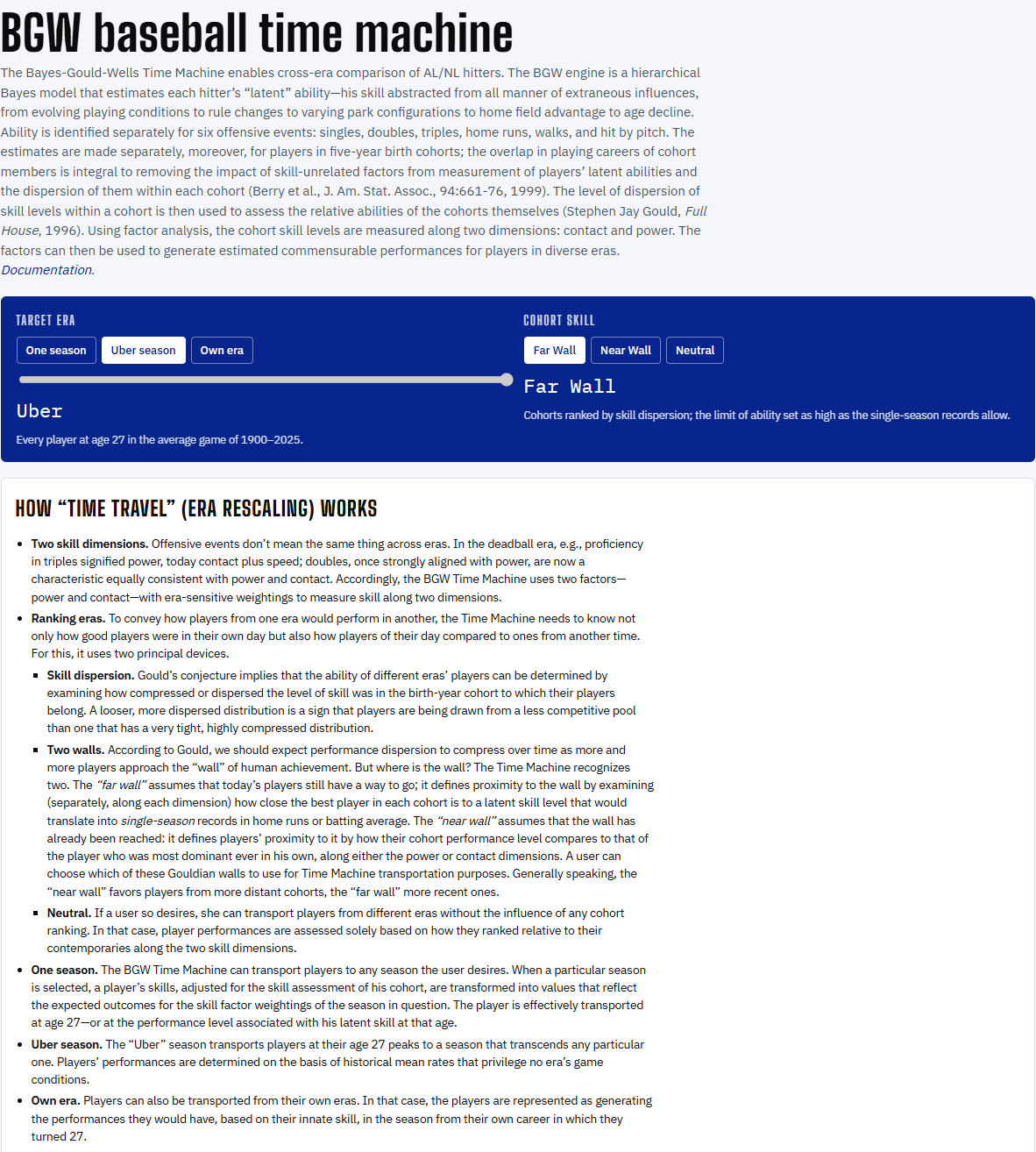 Or alternatively, the Machine can place the players in an “Uber season”—one that effectively averages the impact of player skill across outcomes, thereby enabling players to be evaluated—for batting average, team run production, home run hitting, and the like—in a manner that doesn’t privilege game conditions of any era.
The Machine can also make determinations subject to alternative assumptions about how relative cohort-skill levels should be assessed. The Machine has different “Walls,” each of which reflects a different theory about how “close” the best in each birth cohort is to the highest attainable level of player achievement.
These achievement “Walls” reflect the Gould Conjecture, which posits that as a sport matures, the distribution of top performances becomes more and more dense, as players drawn from progressively deeper talent pools start to bunch up at the outer limit of human performance capability.
The Machine’s “Near wall” assumes that players should be measured by the “best ever” player—the one most remote from his skill-adjusted cohort mean—along the dimensions of “contact” and “power.”
The “Far wall” assumes that players should be measured against an even more remote standard identified as a level of performance that would imply a player’s latent age-27, peak-skill level would be equivalent to the single-season record for a particular offensive metric—a herculean standard, since single-season records are always huge outliers in relation to the skill distribution.
Or if you just don’t believe the Gould Conjecture, you can transport players in a manner that is “cohort neutral,” ranking players based purely on how dominant they were relative to their contemporaries.
So just go to the Machine and start traveling!
But to get a sense of some of the weird things you might discover, consider triples.
It really would be a mistake to assume that what a triple is has remained constant over time. In the early part of the 20th century, triples were associated with power; they were a slugger’s long hit.
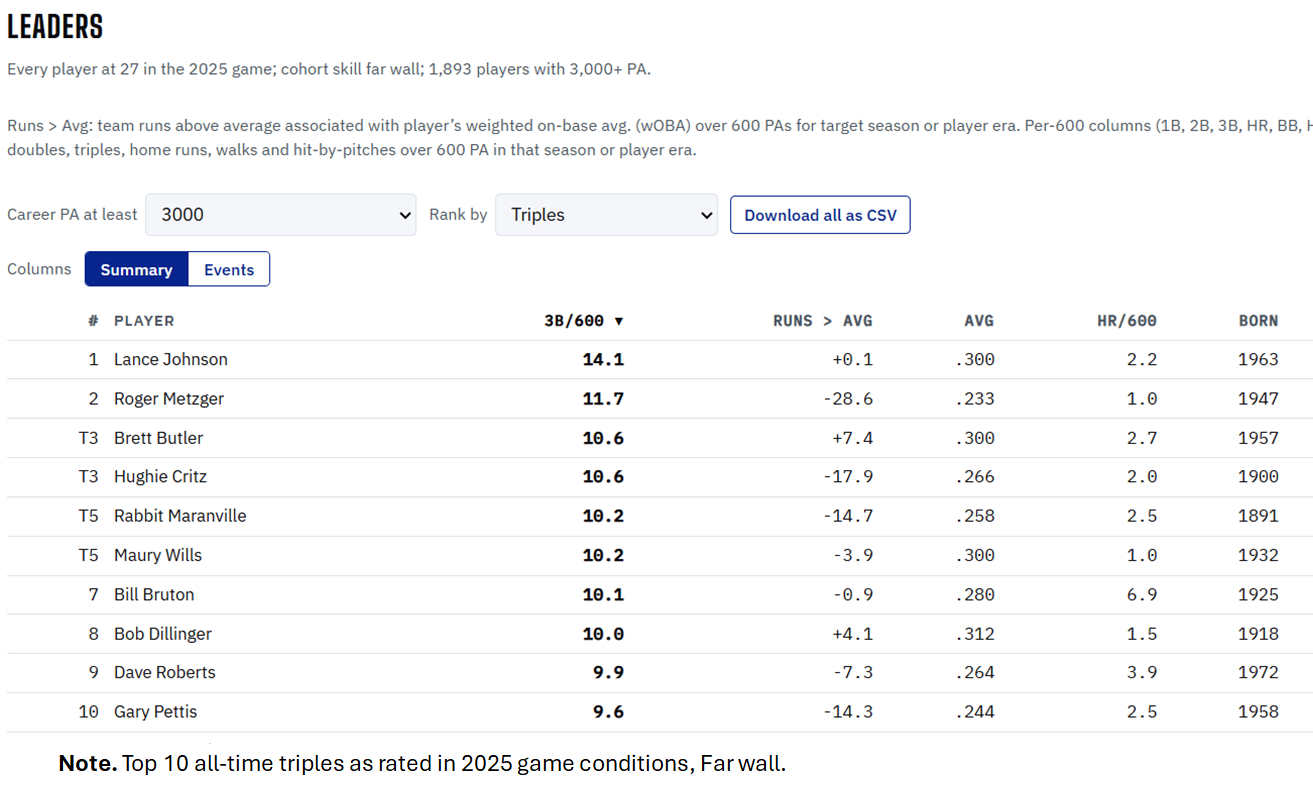
Today, in contrast, they play virtually no part in the power hitter’s profile. Instead, they are an element of contact that is influenced by player speed.
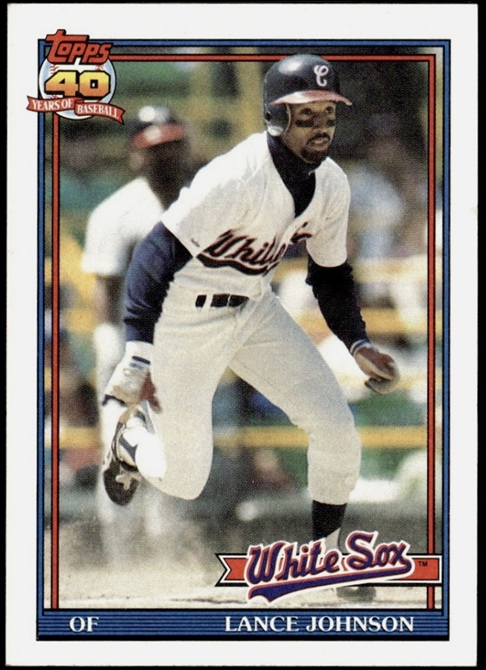
If you transport everyone to 2025, you’ll see that Lance “One Dog” Johnson would (under the “Far wall” setting) be viewed as the greatest triples hitter of all time. This is very plausible, since One Dog was known to hit triples at an extremely high rate.
But if you transport players to 1901, then you’ll really be in for a shock!
Evaluated in the playing environment of that day, Shohei Ohtani is the greatest triples hitter ever! The Machine awards him 19.6 triples for a 600-PA season (again, a the “Far Wall”).
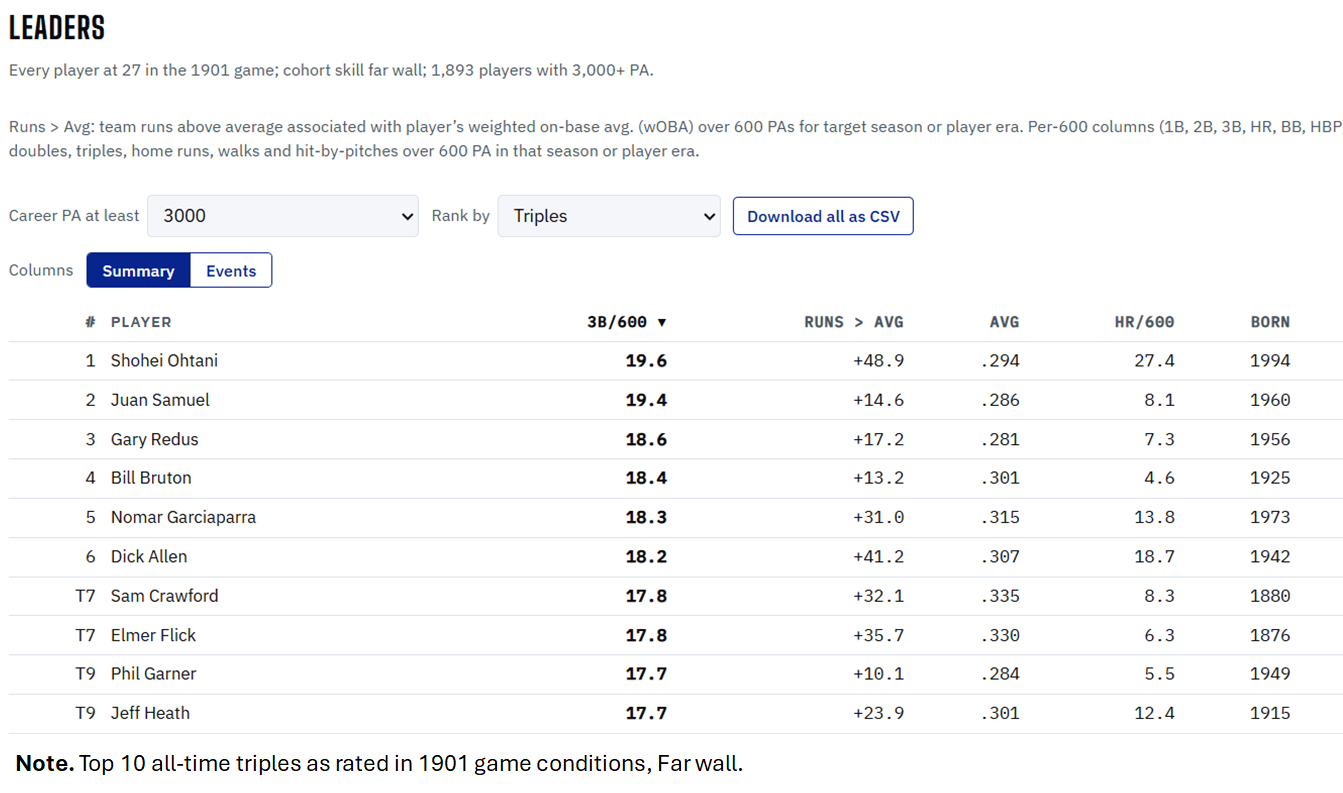 The reasons are two. First, as I mentioned, triples in earliest part of modern baseball were associated with power, not contact plus speed per se. The power Ohtani uses to hit home runs today would have resulted in a healthy number of triples.
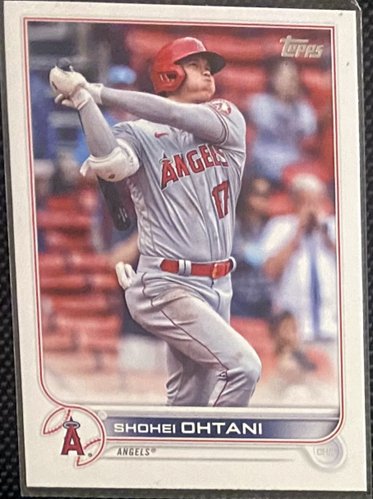 Second, Ohtani, among hitters generally, outperforms in triples relative to his power/contact profile. So he gets a Bayesian “bump” in triples relative to contemporary hitters with slightly more power when they are all transported to 1901!
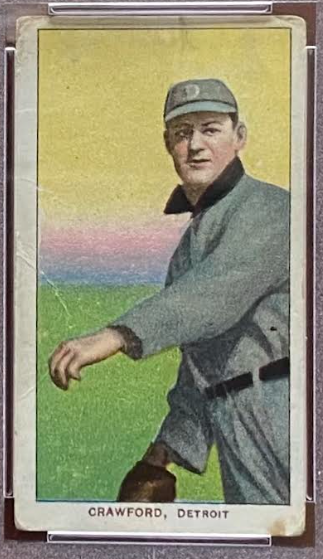
Sam Crawford, the greatest triples hitter when measured in sheer numbers, ranks 7th when rated in 1909 at 17.8 per 600 PA. Apparently, though, his skills would be ill suited for the modern game: in 2025, he’d rank 150th with a mere 5.3 three-baggers per 600 PA.
As indicated, I’ll have more to say in subsequent posts. If you are dying to know details, though, there’s a documentation link.
But for now, head over to the page and construct your own “all time -boards” at the time-travel destinations of your choice.