
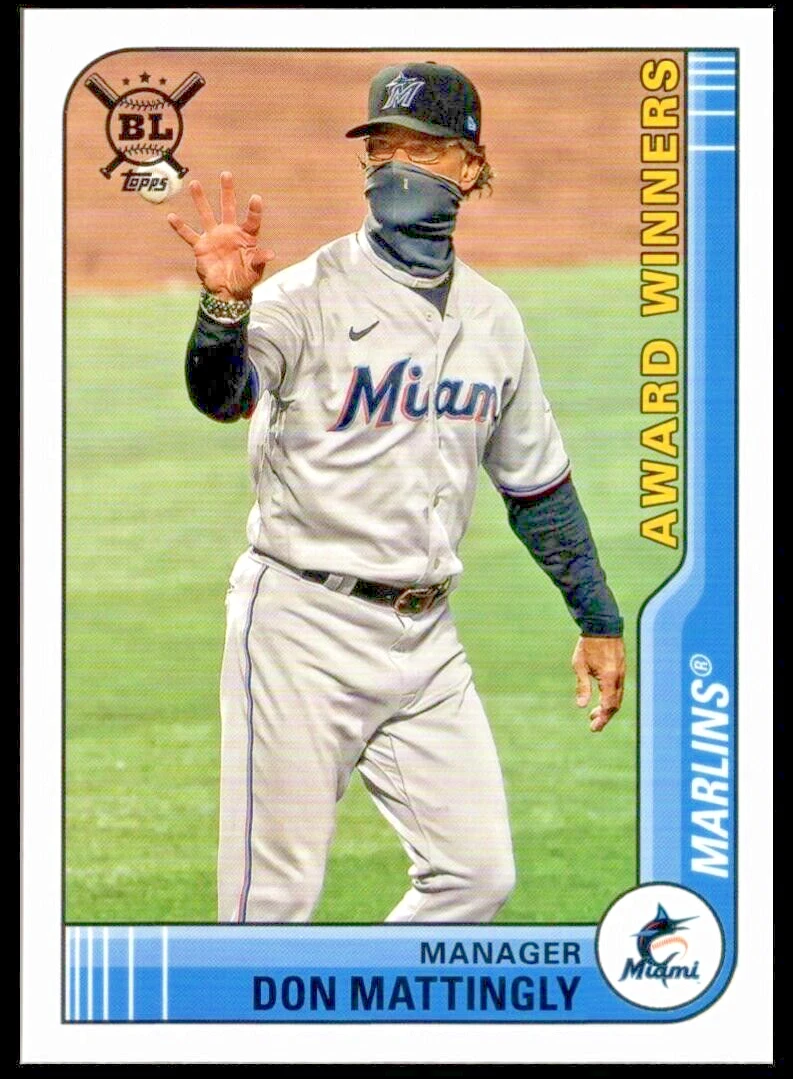
 Is Terry Francona the manager of the year?!
As all 5,033,941 regular readers of this blog know, the mWAR manager-value estimator measures a manager’s contribution to his teams’ performances in “wins per 162 games.” This mw162 score is based on a running tally of his season performances. That is, after each season, the estimator updates its assessment of that manager, who it assumed at the outset had an mw162 value of 0.
One consequence of this method is that the estimator never purports to specify what impact a manager had in any particular season. Its estimand is a latent or unobserved level of proficiency that is assumed to be present in the manager from the outset; each season’s performance is just evidence of what that persistent level of impact is.
That’s a bit frustrating. If you are a practical decisionmaker—say, a GM or bookmaker—you might not want to wait the number of seasons it takes—about 5—for the estimator to lock into a confident assessment of a manager’s mw162. And if you are an ordinary fan, you are no doubt interested in being able to identify season leaders: we do it for hitters and pitchers, so it is reasonable to want to do it for managers, too.
Fortunately, the mWAR evaluator has a little sibling, mw162p.
The mw162p is a one-season variant of the full estimator. The “p” stands for “provisional,” since it is envisioned as furnishing assessments as one waits for the mWAR estimator to form a mature judgment of a manager’s mw162 latent skill level. But that same provisional output can also be used to satisfy our interest in making a season-specific judgment.
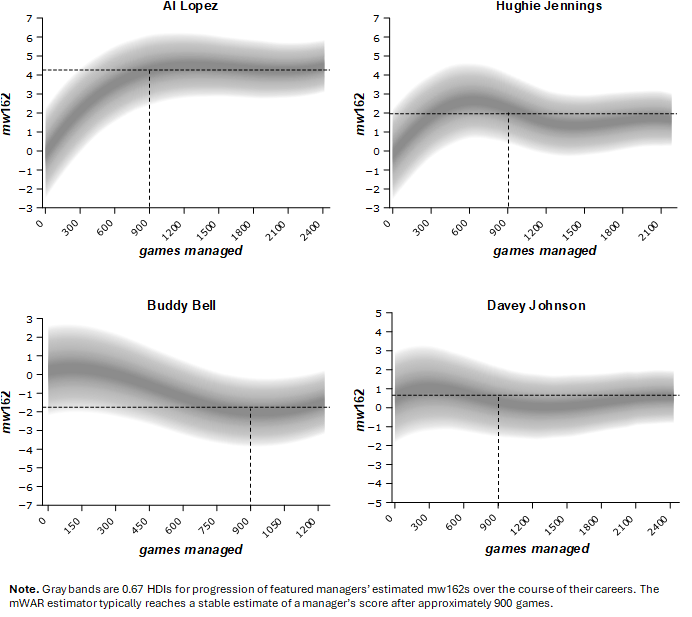
Basically, what mw162p does is assign every manager the “average manager share” of the difference between his team’s actual performance and that team’s WAR-predicted performance. The accumulation of those differences season-over-season is the data stream that the mWAR estimator uses in its running assessment of a manager’s mw162—his latent managerial skill level.
By studying AL/NL baseball since 1900, the estimator has figured out about what fraction of this difference is attributable to differences in managerial acumen. The answer is roughly 24%.
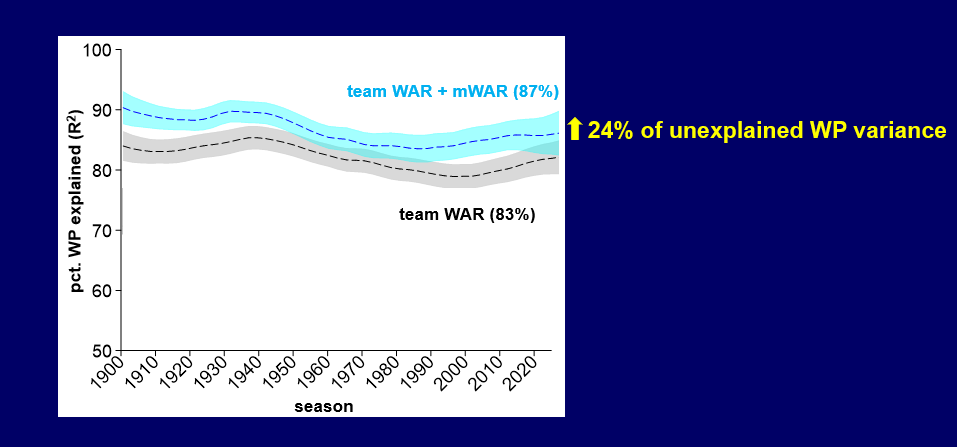
So every season, a manager’s mw162p is calculated by awarding him (someday him or her) 24% of the difference between how many wins that manager’s team achieved and how many we would have expected it to garner based only on the cumulative WARs of all the team’s players.
It’s only a rough-and-ready approximation of the manager’s contribution. He might be due more or he might be due less; if we kept track of how he did for about 900 games or so, we’d be able to assign him a share that is much more tailored to his personal impact relative to that of other managers.
But an mw162p not a bad approximation if we want to form a one-year score. We just have to remember, though, that this score, like a lone season’s statistical measure of hitting or pitching performance, is necessarily only a noisy guess of true ability. That’s just the way it is for a game as filled with chance as baseball.
In my Journal of Sports Analytics article, I reported mw162p scores for 2024 and 2025. Here they are:
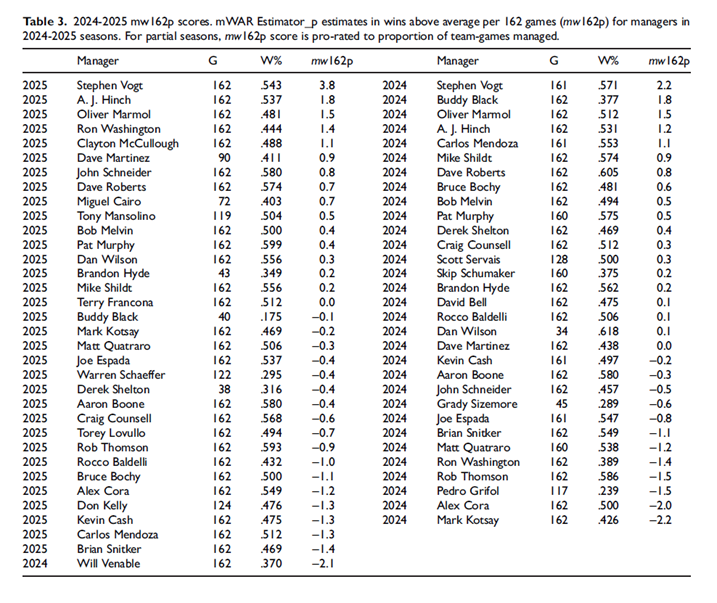
I was heartened by the level of consistency in them. Steve Vogt was the top manager in both seasons. Oliver Marmol was third both seasons. For both seasons, A.J. Hinch did really well. And for both, Alex Cora stunk.
Well, here’s this season:
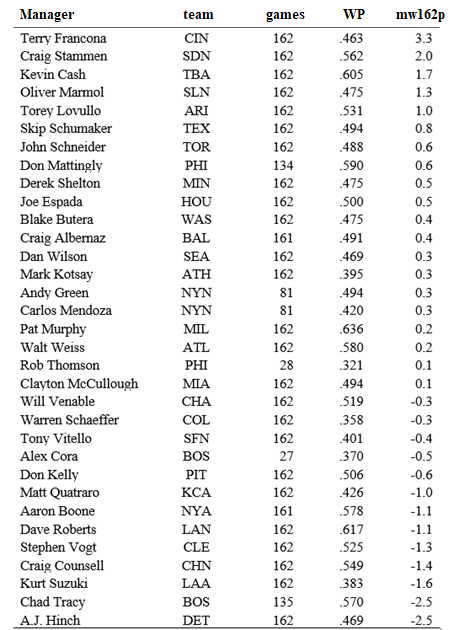
Consistency took it on the chin, I have to admit. Steve Vogt had a bad season, and A.J. Hinch a horrendous one!
Oliver Marmol, at least, was still perched near the top.
I haven’t had a chance yet to feed 2026 to the full mWAR estimator yet, but Vogt, as a reasonably new manager, is likely to be punished even more than Hinch, who the estimator already knows very well based on his nearly 2,000 games managed. For the same reason, I don’t think the relatively poor seasons of Dave Roberts or Craig Counsell will do much to reduce their high estimator ratings coming into the season. Nor would I expect Aaron Boone’s mediocre year to have much effect on his existing mediocre score. But I’ll fire up the full estimator and post the updated scores soon.
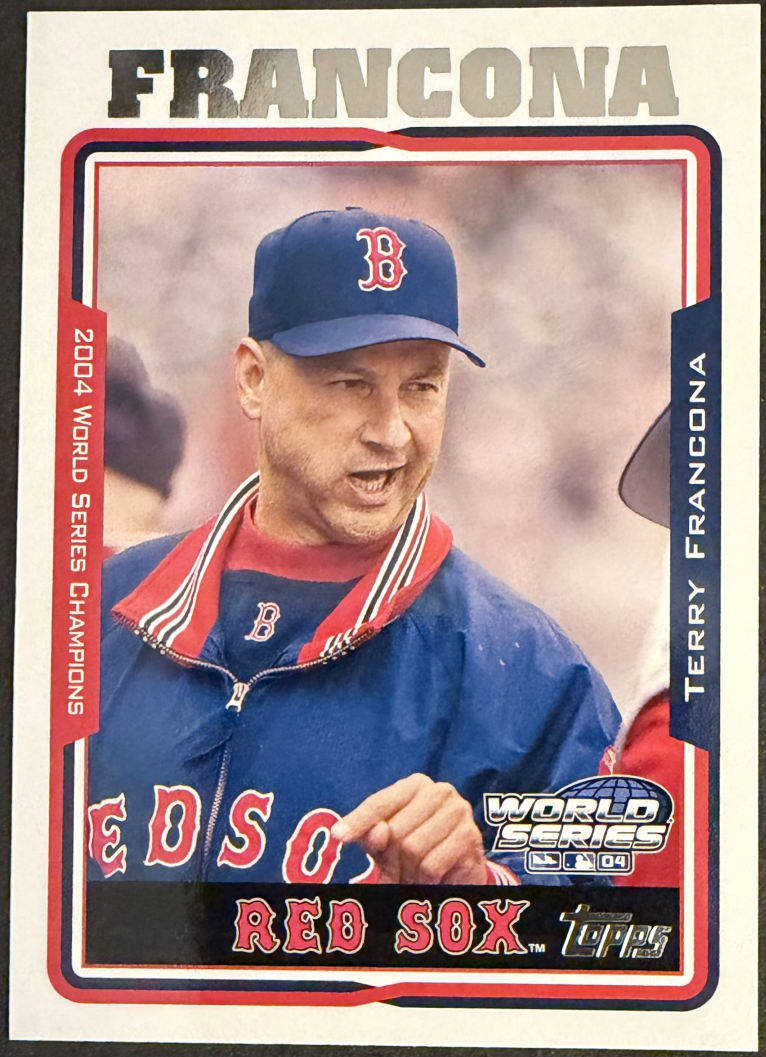
Terry Francona’s season-leading performance is really interesting. The Reds were one of the worst teams in baseball—but according to the provisional estimator, he is manager of the year! I hope he at least manages (so to speak) to avoid being fired.
The favorite for the official BBWAA “Manager of the Year” award is probably Don Mattingly. He took over the helm for the Phillies after the first month of the season when they were 9-19 and steered them to an 88-74 record and a Wild Card berth, a 24-game turnaround.
But the mw162p was not super impressed, crediting Mattingly with 0.6 wins added. This won’t make a dent, either, in his mw162, which was -0.9 coming into the season.
Not much more to say—except that the results do leave me with an appetite for tinkering and refining. The problem is that any single-season measure that is genuinely Bayesian in nature is going to give everyone a score close to 0, since the ratio of sampling variance to genuine between-manager heterogeneity is just too high to move anyone off the population mean after only 162 games.
But I’ll keep thinking about it!